
Apoptosis
Apoptosis (a.k.a. “programmed cell death”) is a form of cell death in which an ordered series of events leads to destruction of a single cell without release of unwanted material into the tissue milieu (c.f. necrosis, with the risk of inflammation).
Apoptosis has a central role in development and maintenance of the healthy multi-cellular organism – deleting aging, obsolete or damaged cells. When control of apoptosis is lost, cells that should be deleted can become immortal as in cancer. Conversely, excess apoptosis will cause tissue damage.
The biochemical changes that occur in the apoptotic cell can be observed morphologically, through DNA fragmentation, plasma membrane inversion, membrane permeabilization, caspase activity, mitochondrial membrane potential change and more.
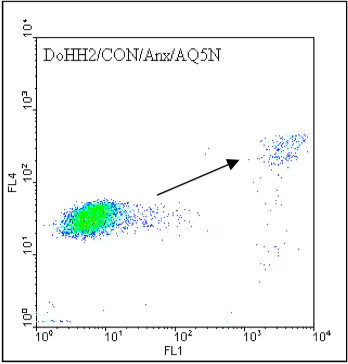
Flow cytometry is the most common tool for analysis of apoptosis allowing multi-parameter interrogation cell-by-cell.
Cell permeabilization is a late hallmark of apoptosis and this can be monitored using the far-red viability probe DRAQ7™ which can also be used in long-term, real-time assays due to its ultra-low toxicity. Far-red APOPTRAK™ differentially labels both intact and permeabilized cells. Both of these probes can be combined with commonly used markers of apoptosis such as Annexin V, TMRM and caspase substrates.
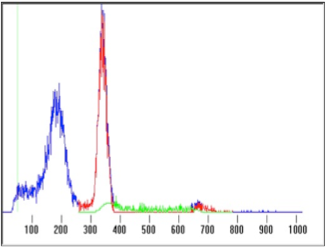
Cell cycle analysis can provide valuable information on apoptosis as indicated by a sub-G1 peak in the DNA histogram. The far-red cell-permeant DNA probe DRAQ5™ does this without time-consuming and damaging RBC lysis, cell permeabilization or RNase treatment.
Related BioStatus Products for Apoptosis (Flow Cytometry)
DRAQ5™ in Apoptosis (Flow Cytometry)
Proven far-red, cell-permeant probe for simple, direct DNA content analysis.
DRAQ7™ in Apoptosis (Flow Cytometry)
Reliable identification of apoptotic/dead cells at endpoint or in real-time.
APOPTRAK™ in Apoptosis (Flow Cytometry)
Differential labeling of intact, healthy and membrane‐compromised cells.
Fluorescence microscopy allows combination of phenotypic and morphological features in the study of apoptosis, while permitting real-time monitoring.
Cell permeabilization is one late hallmark of apoptosis and this can be monitored using the far-red viability probe DRAQ7™ and it can be easily combined with commonly used markers of apoptosis such as Annexin V, TMRM and caspase substrates due to its far-red fluorescence. Uniquely, DRAQ7™ can be used to monitor cell viability in long-term, real-time apoptosis or cell health assays due to its ultra-low toxicity.
In image-based assays a nuclear counterstain is often needed. The far-red DNA counterstain DRAQ5™ allows for live- or fixed-endpoint experiments alongside other fluorescent markers of apoptosis.
Time-lapse imaging of apoptosis in de-adhered or non-adherent cell types requires gentle and physiologically appropriate immobilization. The thermo-reversible mountants CyGEL™ and CyGEL Sustain™ have been used to study apoptosis (anoikis) in de-adhered epithelial cells.
Related BioStatus Products for Apoptosis (Fluorescence Microscopy)
DRAQ5™ in Apoptosis (Fluorescence Microscopy)
Far-red DNA counterstain, nucl:cyto segmentation in live- / fixed-end point assays.
DRAQ7™ in Apoptosis (Fluorescence Microscopy)
Reliable identification of permeabilized cells at end-point or in real-time.
CyGEL™ in Apoptosis (Fluorescence Microscopy)
Convenient immobilization of live non‐adherent cells.
CyGEL Sustain™ in Apoptosis (Fluorescence Microscopy)
Culture medium-specific immobilization of live non‐adherent cells.